Tuesday, May 15, 2012

The Seven Year Itch Review

The Seven Year Itch
(Salisbury Playhouse, Salisbury)

For the last few years the Salisbury Playhouse has surprised me. It has put on some fine productions such as A Taste of Honey, Arsenic and Old Lace, and Private Lives. I was even impressed by the way they would go to great lengths when designing and constructing the sets, from the van in The Lady in the Van, to a temporary theatre-in-the-round for last year's Way Upstream, with the stage consisting of a water tank with a real boat within. I was quite interested in seeing one of their first productions this year, The Seven Year Itch, a 1952 play by George Axelrod on which the 1955 film with Marilyn Monroe was based. But does this production hold up to the Playhouse's preceding productions?

A publishing executive, Richard Sherman (Gyuri Sarossy), stays in his apartment whilst Helen Sherman (Hattie Ladbury), whom he had married seven years ago, and his son go on their summer holiday. He meets a girl (Verity Rushworth), a model who is living in the apartment above him, after her tomato plant of hers falls and narrowly musses him on his balcony. He becomes attracted to her and invites her down to his apartment. His growing desires leaves him divided between his wife and this girl.

The best moments of the play are when Richard Sherman is on his own, during which he breaks the fourth wall and tells the audience his thoughts. This slice of life was quite interesting to observe, and Gyuri Sarossy was convincing as an 'average joe' who tries to fight off his desires for the girl. It almost felt as though I was sitting in his apartment and chatting with him like an old friend. I would have preferred to listen to him  rather than Verity Rushworth as the 'girl'.

Fortunately I have not seen the film, so I cannot start comparing Rushworth to Marilyn Monroe. She does show the girl's naivety to Sherman's advances. Yet she did not seem convincing as a girl who would attract Richard to the point where he would go back and forth between her and his wife with such passion. Any further advance made by Richard did not seem believable. I even wondered whether the tomato plant incident was a moment of ambiguity. Was it an accident or intentional? Yet Rushworth made this sense of ambiguity feel void of any need to consider.

Otherwise the supporting cast members provided some comedic and entertaining moments during the play. Gerard Murphy plays Dr. Brubaker, a psychiatrist who has his novels published by Sherman, a large, puffed up man who attempts to assess his publisher's desires. Hattie Ladbury and Michael Stevenson play Helen Sherman and Tom Mackenzie who, according to a suspicious Richard Sherman, is her supposed to be her lover. They play the love scenes Richard imagines dramatically

These imaginary scenes were well stylised. The set would be lit in pinks and blues to show Richard's neurotic mind. The scenes were played as though they were straight out of a movie, the high point happening during the second act, where a homely scene takes a dramatic U turn. Again the Salisbury Playhouse has done wonders creating a big apartment onstage, with kitchen, balcony, staircase and piano included

Once again the theatre has proved that a local in-house production can pull the stops out to create a detailed setting. The supporting characters brought some great moments to the production, yet the main elements of the story could not carry the production entirely. Gyuri Sarossy could on his own, yet Rushworth did not have the charisma to pull off the alluring girl that Sherman madly falls for. This overall is worth a low Bargain

Measure for Measure Review

Measure for Measure
(Swan Theatre, Stratford-upon-Avon)

I am looking forward to seeing four Shakespeare plays new to me onstage this year. This is mostly due to the World Shakespeare Festival that is taking place this year, during which I will be seeing King John and Troilus and Cressida at the RSC, and hopefully Timon of Athens as part of the National Theatre Live Season. Outside of this festival, the first play I have just seen is Measure for Measure, one of Shakespeare's later problematic comedy plays, which is an intriguing story, different from the usual Shakespeare comedy.

The Duke of Vienna, Vincentio (Raymond Coulthard), announces his intentions to leave the city for a while, during which his trusted deputy, Angelo (Jamie Ballard), would be left in charge. In fact the Duke secretly remains in the city dressed as a monk, so that he can observe Angelo's regime, which turns out to be strict. Under his new laws against sexual licence, Angelo has Claudio (Mark Quartley) sentenced to death for making his lover Juliet (Sarah Ovens) pregnant before they are lawfully married. Claudio asks his sister Isabella (Jodie McNee), a novice in a nunnery, to go to Angelo and persuade him to pardon her brother. Angelo asks a horrified Isabella to defy her beliefs and have sex with him before he pardons Claudio. The Duke secretly helps Isabella find a way to free her brother.

Sexuality was the main theme of the production from the get-go. There is a sense that Vienna is built upon strip-clubs and brothels, as leather clad men and women participate in sexual acts. Even the Duke wears a tightly fitted corset, and during the scenes that were set in his palace there were always two women standing with spiked leather lampshades worn over their heads. However, it is unclear why they remained whilst Angelo was in charge. Claudio and Juliet were first shown in chains with fetish pieces attached to shame them. It was interesting to see a mix of both sixteenth century and modern undertones to the theme, showing that attitudes to sex are no different now to the 16th century. If I did have an issue, it would be that as the play progressed the theme was used less and less, and the setting became primarily sixteenth century. It was a shame that director Roxana Silbert could not have taken the theme all the way through the production.

Raymond Coulthard dominates the stage while carefully planning how to deal with Angelo. From the start he shows that he is in control by clapping to bring down the house lights. He even gives the impression that he manipulates the events that take place, revealing rolled up letters out of nowhere, giving a bewitching edge to his supremacy. Jamie Ballard presented Angelo as someone who would object to the sexual deeds that were taking place in the city, yet struggled to stand by his laws when Isabella was pleading with him to free her brother. The moment when he falls for Isabella was interesting, because he is taken aback and becomes bashful. This however made his sudden desire to have sex with her out of character. Jodie McNee plays the virtuous Isabella with frailty, yet firm in her compassionate support for her brother when some of the other characters would write her off as collateral damage. Paul Chahidi plays Lucio, a bachelor and friend of Claudio who at first helps him, yet changes sides every time he sees an opportunity that benefits him, without consideration of people like Isabella. Paul plays this slippery man with flamboyance and glee, and it is hilarious seeing his reaction the moment when everything goes wrong for him.

In fact there was a number of entertaining supporting characters who brought some colourful moments to the production. There is a subplot where a rogue named Pompey (Joseph Kloska) is imprisoned for his involvement with the brothels, and is given the option to become an assistant to the executioner, Abhorson (Youssef Kerkour), for which his crimes will be forgiven. Here we are given another angle on society in Vienna from the confines of the prison, and Kloska gave the audience a hilarious moment describing the crimes committed by some of them. Plaudits must also go to Daniel Stewart as Barnardine who staggered drunkenly from beneath the stage, refusing to be executed. Elsewhere, Ian Midlane played Elbow as an overweight man child who would throw tantrums in frustration. Annette McLaughlin played the owner of a brothel, Mistress Overdone, who faces her loss of livelihood with dignity. This play has so many characters that represent different parts of society, and the actors played them with embellishment and clarity.

The design too brought a colourful edge to the production. Adding to the theme of sex, the set at the back was dominated by long, hanging, leather whips. With certain lighting they brought some depth to the scenes. At one point the Duke stood behind them whilst eavesdropping on a conversation, and by the end they were raised for a grand entrance. Their length also gave a sense of scale, and the lighting helped to establish such scenes as the dungeons, the streets of Vienna and the flora within Mariana's (Catherine Hamilton) garden. The traditional theme of the underworld beneath the stage is also put to good use as prisoners lumber to and from their cells.

I hear that this is a difficult play to put on, but this is the first time I have seen a production of this play and I found it both easy to follow and entertaining. The characterisations were colourful and the production went to great lengths to establish the sexual attitudes that were rife within Vienna. For newcomers to the play this is easily worth a high Top Price.

Sunday, April 22, 2012

The Comedy of Errors (NT Live) Review

The Comedy of Errors
(Olivier Theatre, National Theatre, London - National Theatre Live Screening)

The National Live season continues with the National Theatre's production of The Comedy of Errors. The play is one of Shakespeare's earliest plays and although one can easily see a few holes in the plot, I always look forward to seeing how a production will approach the mishaps and hilarity that occur during the play. This was also a chance to see Lenny Henry demonstrate his acting abilities after his success in Othello.

During the introductory trailer before the production started, Director Dominic Cooke said that because it was one of Shakespeare's first plays, The Comedy of Errors has a simpler story than his later plays. His intentions were to expand upon a number of issues and themes within the play.  One was to give a darker tone to the play, and it was certainly the case during the first scene, where Egeon was interrogated by the Duke in a dark room. Changing the setting to London also gave a gritty look to the production. Another issue that Cooke used was immigration, by showing that the twin brothers from Syracuse and their natural and adoptive father were of Afro-Caribbean descent, and that they go travelling to far off lands to find their missing relatives. It was interesting seeing the travelling brothers cope in a different country. Lenny played Antipholus authentically with a strong Afro-Caribbean accent, and throughout the production he and Dromino would react to several aspects of a foreign society with wide-eyed confusion whilst enacting chants to ward of these supposed "liberties of sin". However, in the end the play is a simple comedy and as soon the chaos takes over these themes are soon forgotten about. The exception comes at the end, where everything comes to a resolution that was bordering on emotional.

Lenny Henry and Lucian Masmati were the highlights of the production, both because of Lenny's acting abilities and the way their ethical backgrounds are portrayed. The other brothers are very good, though less interesting because they did not need to use particular accents like Lenny Henry. Claudie Blakley and Michelle Terry played the wife and her sister as Essex girls, which was very good though I thought Claudie over did it climbing on a pool table seductively when she first finds Antipholus of Syracuse.

Despite the efforts to change the setting the scenic designs did feel a bit static in the end, which undermined the comedy in the play. At first, it was nice to watch twenty first century Londoners react to the events of a late sixteenth century play, but as the production progresses the stage becomes empty. The Brothers of Ephesus' house consists of a balcony and the main door into a block of expensive apartments, which takes away some of the intimacy of the scenes that are set there. The front door scene for instance is basically boiled down to the Ephesus brothers shouting through an intercom, which constricts what movements they can achieve in the scene

Furthermore, what makes this play fun to watch is seeing the residents of a town cope with the incidents that suddenly occur once these strangers appear. For instance when both sets of brothers are being hunted down because of their supposed madness, the whole town is meant to get involved and I always look forward to seeing what unorthodox methods will be used as they struggle to stop them. The advantage of this production was the scale of the set, which was an entire block of buildings from which the brothers would dart in and out during the chase. Yet I never got a sense that the whole of London was involved. Instead the brothers were being hunted down by the equivalent of the NHS and Metropolitan Police, and it is not rocket science guess how these characters would be stopped. Elsewhere, it is clear that the use of band is a sign that the production was riding the One Man, Two Guvnors bandwagon, and although they were another example of immigration by having them sing in a different language, it felt unnecessary.

In the end this production is hilarious in some places but never reaches farcical heights. Also, although they were interesting to observe, the issues that Dominic Cooke brought up soon got lost as this comedy progresses. On the other hand some of the performances, like Lenny Henry, where entertaining to watch. The scale of the set meanwhile enabled some enjoyable moments, though some scenes either felt empty or lacked intimacy. This is worth a low Bargain.

Sister Act Review


Sister Act
(Tour - The Mayflower Theatre, Southampton)

After seeing South Pacific I needed to see a more energetic musical, and what better than Sister Act. Based on the Whoopi Goldberg film, the musical premiered a few years ago at the London Palladium and is now touring around the country. I had previously seen some of the film. I am also familiar with the cast recording and enjoy a number of the songs. I therefore went in expecting to be entertained by this musical.

Deloris Van Cartier (Cynthia Erivo) is a singer with ambitions to become a Diva. However, she sees her boyfriend, a gangster called Curtis Jackson (Cavin Cornwall), shoot an undercover cop. She escapes and with the help of a police desk chief, Eddie (Edward Baruwa) who happens to be an old school friend of hers, she enters the witness protection programme and is sent to a languishing convent. Here Deloris struggles to accept life as a nun under the disdainful eye of the Mother Superior (Denise Black). However, she finds a way to use her singing talent to revamp the convent's choir, which revives the convent's popularity.

Overall the songs that are sung by Deloris, with and without the choir, are the best moments of the musical. It is thrilling watching her and the nuns sing the biggest ensemble pieces during the production. Elsewhere Curtis' henchmen provides some comedic moments, such as the song 'Lady in the Long Black Dress', whilst Eddie has a touching moment telling us of his desire to impress Deloris during 'I could be that guy'. However some songs were cut from the musical, such as 'It's Good to be a Nun' and as a result some of the characters feel less rounded. It did feel as though the characters came under two groups,  the gangsters and the nuns, and most of them never stood out.

Cynthia Erivo as Deloris is the driving force of this musical. She has a strong voice and I enjoyed watching her play the role. The same can be said for most of the cast, despite the cuts, and Julie Atherton, Laurie Scarth and Jacqueline Clarke played sisters Mary Robert, Mary Patrick and Mary Lazarus with vigour. So too did Michael Starke as Monsignor O'Hara. Cavin Cornwall was charismatic as the leader of the small mob, played by Gavin Alex, Daniel Stockton and Tyrone Huntley. However I was looking forward to seeing the Mother Superior, after listening to Sheila Hancock singing Here within these walls, but I felt that Denise Black struggled with her songs. I would have preferred to have seen someone older in the role, like Sheila Hancock.

The sets were very good, especially during the ensemble and dance sequences. A number of the monastery scenes though were a bit uninspired, as they were shown against the general background of the monastary. A lot of effort was given to the colourful costumes and lighting, especially during the updated choral songs. Also, with the use of a sound system the music was much clearer than that of South Pacific. This was a relief and I was pleased

This was a big step up from South Pacific. Although the story is not coveered as thoroughly as in the the original production, and the set designs were occasionally average, I was entertained by the whole musical. This is worth seeing at a high Bargain.

One Man, Two Guvnors Review

One Man, Two Guvnors
Adelphi Theatre, London

Due to work I am publishing the next few reviews a while after I saw these productions, and my first review is on One Man, Two Guvnors with James Corden. I remember seeing an open air production of Servant of Two Masters by a local company, The Maskers, and quite enjoyed it. I love a good farcical play, and although I have not seen one for the last few years I am a sucker for pantomime, which is based on the plays style Commedia dell'arte. Therefore, this critically acclaimed adaptation, One man, two guvnors, suited me perfectly.

After her brother gets killed by her lover Stanley Stubbs (Oliver Chris), Rachel Crabbe (Jemima Rooper) decides to dress up as her dead relative. She then goes to collect the money that was going to be inherited by her brother from Charlie Clench (Fred Ridgeway), the father of the girl, Pauline Clench (Claire Lams), who was betrothed to the sibling,. She would then use the money to escape with Stanley. However, since the death of Rachel's brother Pauline has been engaged  to Harry Dangle (Martyn Ellis), and when Rachel arrives as her supposedly living brother, tensions arise. Meanwhile Stanley Stubbs, whilst on the run from the law, turns up in town un-beknowest to Rachel. Amongst all this Rachel's servant, Francis Henshall (James Corden), desperate for food decides to work for Stanley Stubbs as well. Whilst serving both masters without them knowing, he finds every opportunity to eat and earn some extra wages.

The play follows the same story as Servant of Two Masters, the exception being that it is not set in 18th century Venice, but in 1960s Brighton. Instead of playing stock characters derived from 18th century characters like Harlequin, the actors play stock 'British' characters, from the received pronunciation speaking gentleman to the cockney mobster.

James Corden was certainly the heart of the show, as the overweight, Harlequinesque, Francis Henshall. A number of time he would broke the fourth wall to speak and ad-lib to the audience. Some offered sandwiches when he asked for one (though he added that it was not an actual question). He even brought some audience members onto the stage to help him carry a heavy box indoors and hide some food for him to eat later. He was a force to contend with at times, but he acts the innocent man child to the point where he can easily be forgiven for any of this.

But James Corden is not the only crowning point of this production. Both Guvnors are such a joy to watch. Oliver Chris is the Hugh Laurie of the play as the jolly and gullible Stanley Stubbs. Jemima Rooper gives her all playing Rachel Crabbe, who succeeds in fooling everyone disguised as her short tempered brother. As someone who is short in height her performance was very believable. With these two personalities it was fun seeing Corden take advantage of Stubbs whilst putting up with Crabbe's outbursts.

Some of the supporting characters were enjoyable to watch. However if there was a downside to the transfer of Commedia Dell'arte to 1960s Britain, it is that the cockney mobster stock characters felt a bit jarring, especially when these characters were the followers of Charlie Clench, the updated version of Pantalone from the original text. The dilemma between Pantalone, his daughter Clarice (Pauline Clench in this production), and Silvio (Harry Dangle), played a large part in the Servant of Two Masters and because of that I did connect with them.

However the characters that represented them in this play spent less time on stage, due to the ever present storyline between Henshall and his two Guvnors, and therefore I was un able to sympathise with them. It did not even help when Pauline Clench is meant to play the damsel in distress like Clarice, to which it is assumed she must be presented as dumb. Combined with her accent, hearing her say "I don't understand" half a dozen times soon got annoying. At first I liked the way Harry Dangle was portrayed as an actor, which allowed him to act the romantic hero of the play. However the fact that he is only seen a few times meant that there was no way to expand upon his character.

The production did a great job showing Brighton on a set that reminisces with trompe l'oeil scenic design, whilst the colourful costumes made the characters largr than life. Another high point, or points, were a number of acts that took place between each scene, a number of which were performed by The Craze. This talented group was very entertaining and gave a musical edge when one would assume that the production could not get any better.

I am finishing this as the 2012 Olivier Awards are coming to an end, and it looks as if I must eat my words in thinking that One Man, Two Guvnors would win Best New Play. However, I did see Collaborators last year as part of NT Live and I would say that both plays are equally great. However, I still remember the pure hilarity and entertainment of One Man, Two Guvnors two months later and I would give this a low Top Price.

Friday, April 20, 2012

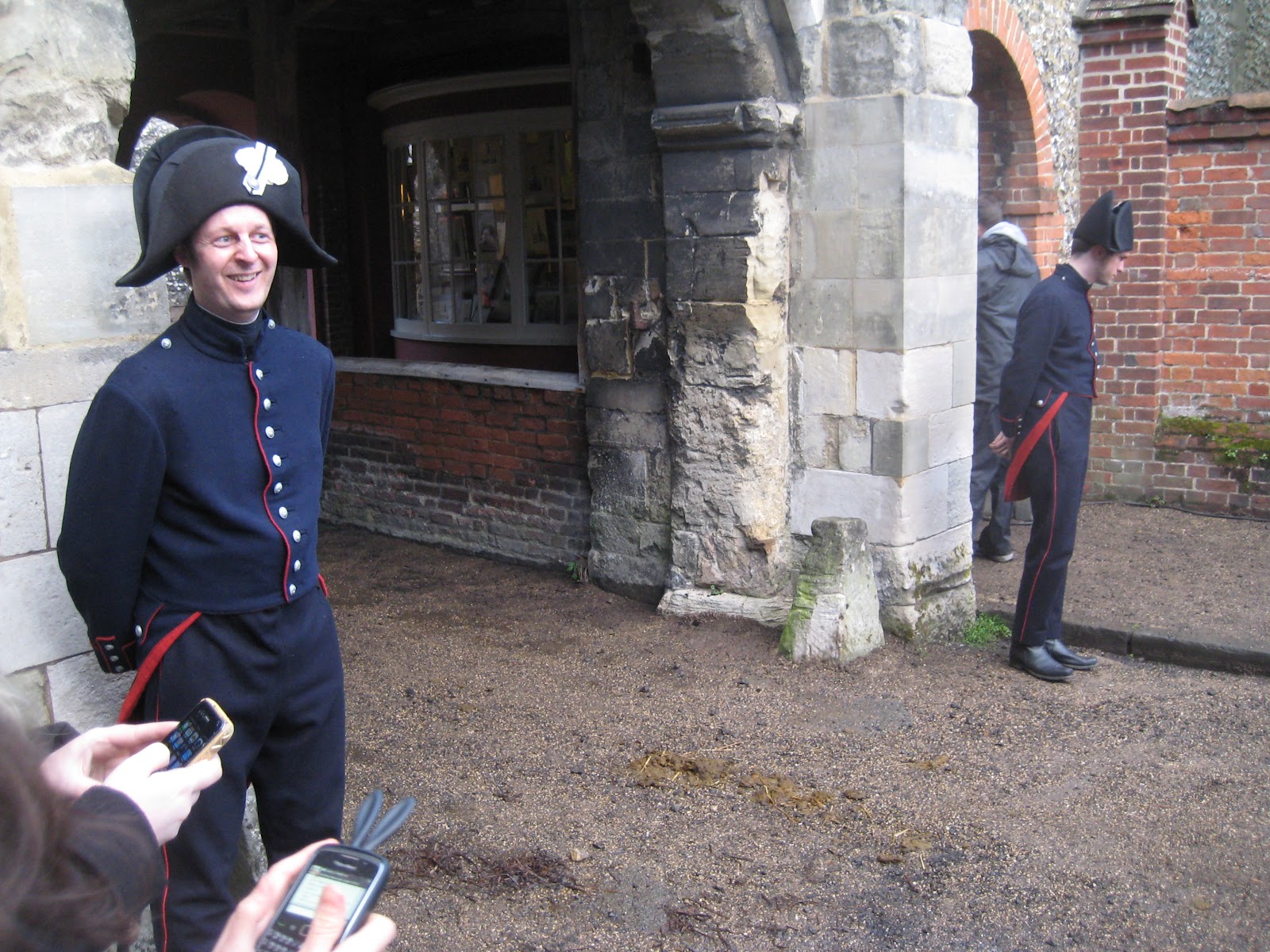
Les Miserables filming in Winchester


Here is a couple of photos taken during filming for Les Miserables at Winchester. The scene that was shot was not the most exciting, just a horse drawn carriage going through an archway. But the place was done up well for the period during the early 19th century in which the musical is set.

Saturday, March 3, 2012

Romeo and Juliet (Headlong Thetre Company) Review

Romeo and Juliet
(Tour - The Nuffield Theatre, Southampton)

Last week I went to see one of the most frequently performed plays by William Shakespeare, Romeo and Juliet, at the Nuffield Theatre and stayed behined to hear a post-show talk on it. So why did I bother going to see this. Basically, I am a fan of William Shakespeare. Not a fan who would shout from the rooftops about it and tell you the meaning of every word he writes, but someone who takes his words as a second language and appreciate them. How that language is used interests me, and I love to see a different and interesting interpretation of a play. My second favourite Shakespeare director would be Rupert Goold, because he has recently given an interesting and vibrant edge to the plays lately. I saw his production of  'Soviet' Macbeth on TV, and I thought his hellish Romeo and Juliet in 2009 and last years The Merchant of Venice (or Las Vegas) were both great productions. He is also Artistic Director of Headlong Theatre Company, and I did see the 2010 revival of their production, Enron, at the Chichester Festival Theatre. The play was directed by Goold himself, and deserved the praise it received in Britain. Therefore, their latest production, Romeo and Juliet, intrigued me and I expected Goold to have influenced this production. I was given a slice of what to expect from this paragraph on a notice about the company in the theatre foyer.
Headlong is interested in theatre that gives provocative questions of the world we live in today in the most vibrant and theatrical forms we can imagine
For the most part I was not disappointed. The company decided to address the theme of fate, by showing how the final tragedy could have been avoided. To start with the plays setting was changed to modern times, in order to ground it in the present. This was helpful because there were projections of a digital clock ticking away in the background, which helped establish the time during a time span of up to 6 days. At certain points in the story the play would first show what could have happened. Moments later the audience would be blinded by a light and afterwards the scene is shown as it was written by Shakespeare. Such moments include Romeo and Juliet's first meeting, Mercutio harassing the Nurse, and when Romeo did not receive the letter telling him about Juliet's faked death. It was certainly disorientating being blinded by a lot of lights, but the point was put across well.

What drives these alternating scenes are the changes to the text. They do not change the play to the point at which its unrecognizable, but they do take out chunks from the text. This helps because with the production going back and forth during scenes the cuts keeps it moving along. The cuts also allow the play to remain true to the production's objective of asking questions about fate In particular the prologue was cut, and in the post show discussion we were told that it was a spoiler alert for what will come in the end. By taking out the prologue the play was able to discuss fate without the audience having a predetermined idea of the final outcome.

However I struggle to see how the play asks provocative questions of the world we live in, despite the modern setting. Fate can be applied to anywhere and any moment in time and we can only look back in time and say 'what if?'. Neither does the production use the theme all the way through the play. The production followed the story of the play right to the end, and the alternating scenes felt like isolated moments. I suppose there is no way to avoid the traditional ending, but  I did wonder whether the production could have been braver and stuck to their questions and exploration of fate in this play.

Because of the modern setting the actors did tone down their characters, with the help of the cuts, from men in Elizabethan clothes, to modern, everyday people in an urban setting. Benvolio was portrayed as an overweight young man who hangs around a burger stand, whilst Friar Laurence did his first speech about plants as part of a lecture. I must give plaudits to Keith Bartlett, who I saw during Michael Boyd's eight play Histories Cycle. Though Romeo and Juliet must have been a smaller weight on his shoulders, he gave a firm performance as Capulet. He plays the character as the man of the house with a no-nonsense attitude, especially when Juliet begs not to marry Paris, yet easily turns into a foolish old man, such as the party scene where he carries on when everyone has already left.

However, Daniel Boyd and Catrin Stewart did not seem convincing as the adolescent Romeo and Juliet. At first I liked how Daniel Boyd started off enthusiastically telling Benvolio about his love for Rosaline, instead of moping around as described in the text, which had also been taken out. Catrin also played Juliet with great passion as a girl who is experiencing love for the first time. Yet both the actors' energetic characters seemed to last for most of the play, which soon got tiresome. They did not even show any grief for the death of Tybalt. Their understanding of Romeo and Juliet almost felt one-dimensional.

The set is simplistic with a platform at the back behined a screen, which is used to display the digital clock before being raised to reveal the platform. Underneath the platform there are two sliding walls which are used as an entrance, to bring on a bed, and to show more than one scene simultaneously. The bed is almost used as an emblem in the play, as it is used in scenes other than those between the lovers. The company estalished the scenes well. During the party the action takes place outside in what looks like the back alley. Lights can be seen beyond the open sliding walls, whilst the sound of music is heard inside. On the stairs to the platform people are seeing kissing and having a smoke. The scenes never feel static. The balcony scene was taken out to be replaced by a bedroom scene to which Romeo looks in from the audience, before entering the room. With the platform the balcony scene could have been kept in and I would have preferred it.

This production looked at the play in a different light, which was both interesting and engaging. Whether this is relevant today is another matter, but it is worth seeing. The company also went to great lengths to establish the modern setting, which was enjoyable. However the leading actors did not impress me as the two main elements of the play, the lovers. This is good enough to see at a Bargain.